
New Species Studied by Lander College for Women Students Is Named After School Dean
Bihenithyris Marianae, An Ancient Brachiopod, Thrived in Rough Currents in the Sinai Peninsula
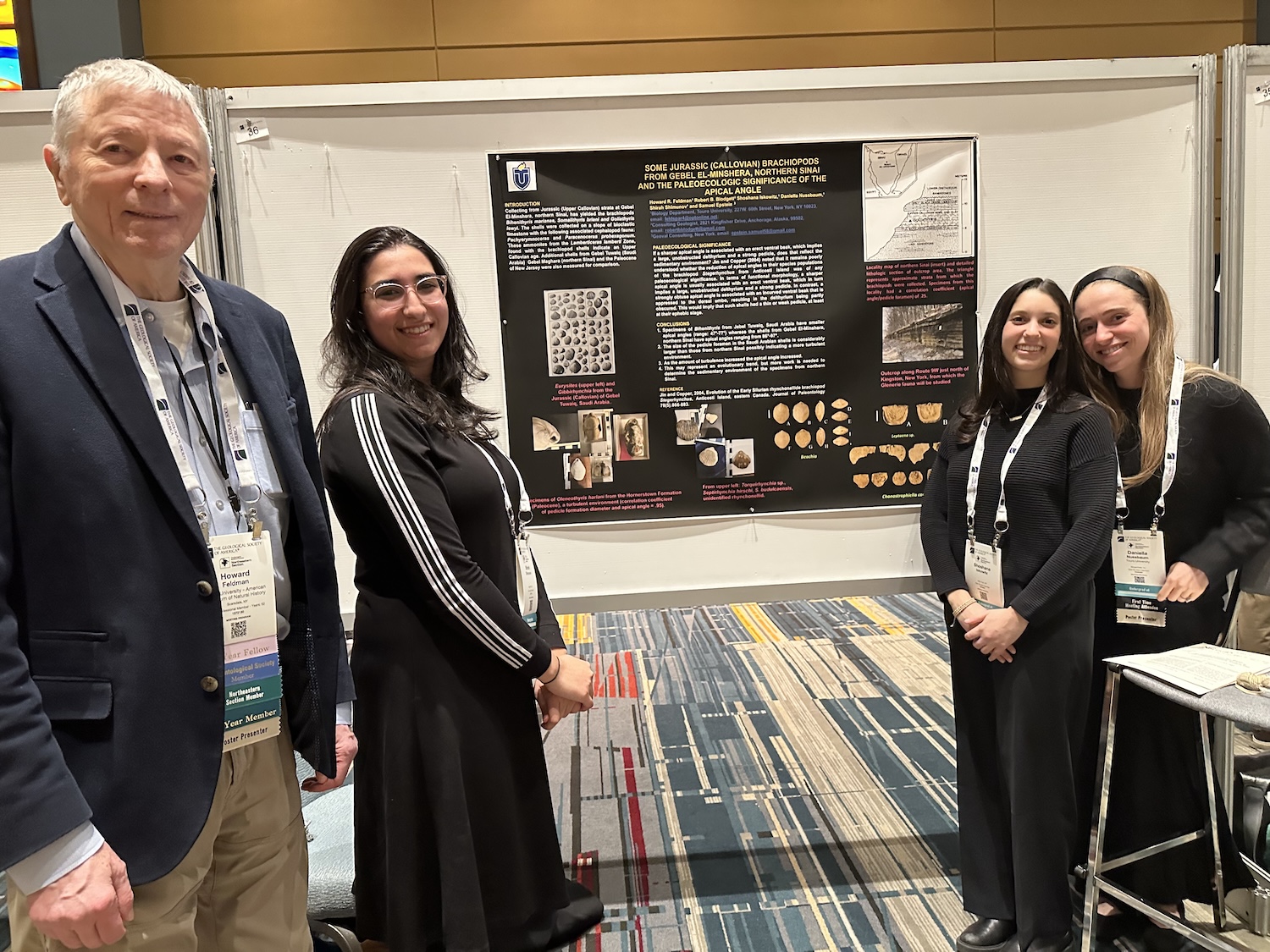
Three students at Lander College for Women helped identify a new species of brachiopod alongside their professor, Howard Feldman, Ph.D. The species, Bihenithyris marianae, is named after Lander College for Women Dean, Dr. Marian Stoltz-Loike.
The students—Shoshana Iskowitz, Daniella Nussbaum, and Shirah Shimunov—presented their findings at the Northeastern Section Meeting of the Geological Society of America meeting in March. While Dr. Feldman made the initial discovery, the students worked to determine the conditions in which the species lived in the Sinai Peninsula.
“It’s definitely something different,” said Iskowitz, a biology major. “When people asked me what I was doing in school, they were very surprised.”
The work began in Dr. Feldman’s Natural History of Dinosaurs course.
“Dr. Feldman is so filled with knowledge that is particular to him—taking a class with him is like opening a door,” said Shimunov.
When the three enrolled in his follow-up course, paleobiology, Dr. Feldman invited them to contribute to his research. He specializes in brachiopods: small, shelled marine organisms, among the oldest known animals, with fossils dating back to early primordial eras.
Decades ago, during a quiet in the Middle East, Dr. Feldman collected samples from the Sinai Peninsula. He has been cataloging them ever since. One specimen appeared to represent an undiscovered species, but its habitat remained unclear.
To investigate, the students analyzed the brachiopods’ morphology, focusing on the apical angle—the relationship between the shell’s structure and its diameter. Larger angles suggest stronger attachment to the seafloor. Across multiple specimens, those measurements can indicate the strength of surrounding currents.
The work was repetitive. The students examined hundreds of samples from Dr. Feldman’s collection at the Museum of Natural History, measuring each one.
“We sat in a café for hours and measured them,” said Iskowitz. “People kept asking what we were doing.”
The process introduced them to the pace and detail of scientific research.
“It really teaches you to open your eyes,” said Iskowitz. “I’ve been on hikes in places where these fossils were found, but it never crossed my mind to pay attention. Now I’ll look at a rock and try to figure out what I’m seeing.”
Shimunov described a similar shift.
“We would walk, and every few steps Dr. Feldman would stop and point to a rock and explain it—fault lines, curves, what formed it,” she said. “I had walked those paths so many times before, but this was the first time I really noticed.”
For Nussbaum, the experience changed how she thinks about research.
“It made me more open to pursuing other opportunities,” she said. “It showed me what that kind of work is actually like.”
Dr. Feldman, who has discovered several new species, named this one after Dean Stoltz-Loike—a decision that surprised the students.
“I think it’s very cool,” said Iskowitz. “We’re waiting for our day to come when one is named after us.”
