Natural Born Scholar
A Preeminent Religious Writer and Popular Professor Brings Alive the Past and Reveals the Promise of the Future to Her Students
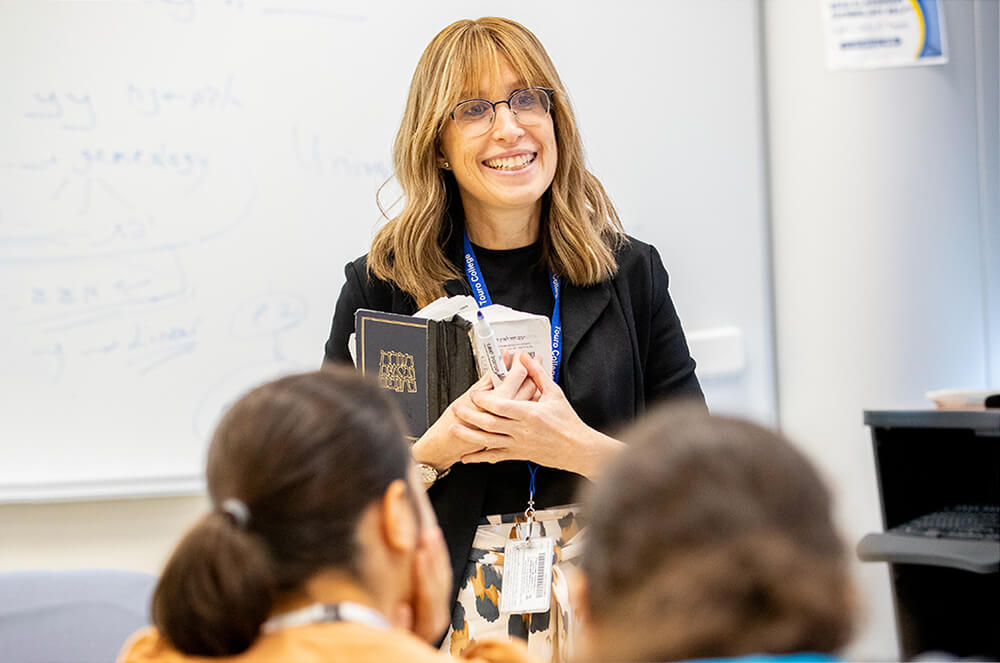
Susan Weissman is not only a revered professor and chair of the Irving Montak Department of Judaic Studies at Touro University’s Lander College for Women (LCW), she holds a Ph.D. in a remarkable and little-known area of medieval Jewish history. She has written about her findings in the scholarly book, Final Judgement and the Dead in Medieval Jewish Thought. Weissman has focused her considerable talent for deciphering ancient texts and unearthing historical and religious accounts on the Jews in medieval France and Germany, and how their beliefs about sin, death and the afterlife were unwittingly influenced by the predominant Germano-Christian society.
Weissman says she took “a deeper dive” than other scholars by concentrating on the mindset of a particular elitist Jewish group, the German Pietists, on the matter of the dead and their world, which revealed far more about the world of the living and even about the Pietists themselves. “In an era in which Judaism and Christianity were existential rivals in a battle for religious truth and singularity, I argue that Pietism was born of a desire to assert the superiority of Judaism by appropriating key elements of monastic devotion to G-d. Instead of questioning the monks’ sincerity of worship, R. Judah the Pious unconsciously adapts and incorporates monastic tenets and practices within Judaism. In this way, Pietists engaged in an altogether different type of polemic against Christianity.”
Putting Training Into Practice
In her classes at LCW, Weissman has taught everything from Biblical Themes to Medieval and Modern Biblical Commentaries.
“My training is in decoding rabbinic and other traditional Jewish texts, which serves me well in Biblical interpretation,” she says. “Also, most of the traditional commentators on the Bible are from the rabbinic and medieval periods, so my historical training sheds light on those periods and texts.”
One of Weissman’s daughters describes her mother as the embodiment of why the tortoise always beats the hare. It took Weissman nearly two decades to complete her Ph.D. program, and she never would have attempted such a deeply rigorous and long-term project if not for having taken a class by a professor and scholar who sparked an intellectual fire within the young undergraduate student. “I was blown away by his methodology and the profundity of his thought,” says Weissman, now 55, of her mentor, Haym Soloveitchik, a world-renowned historian.
She Bent Time to Her Will
Inspiration is a start, but time held a vice grip on Weissman, who had four children—one she had delivered just a few weeks earlier—when she began her Ph.D. work. She had five more when she completed the program. Weissman had the intellect and resolve to navigate the perils of parenting and, at the same time, meet the demands of her academic studies.
“It took me 18 years to finish,” she says, laughing. “It was crazy what I did, but I never thought of quitting.” What kept her motivated for so long? “I loved researching and learning. My parents were deprived of higher education,” she adds. “They, of course, wanted more for their children. And I wanted to learn. In summer camp, no one picked me for their sports team, but I was always chosen for Jewish knowledge contests.”
Weissman and her anesthesiologist husband, who live in New Jersey, spend their leisure time enjoying their grandchildren. These days, Weissman’s passion belongs to the young women in her classes at Lander College for Women. “I love teaching the LCW students, because they truly want to learn and can think critically,” she says. “The beauty, the mission of teaching, is to watch their faces light up. When I see that, I know it’s a good teaching day.”
