A Framework for Their Own Treatment
A Scientific and Religious Expert Helps Students Wrestle with Bioethical Questions from a Jewish Perspective
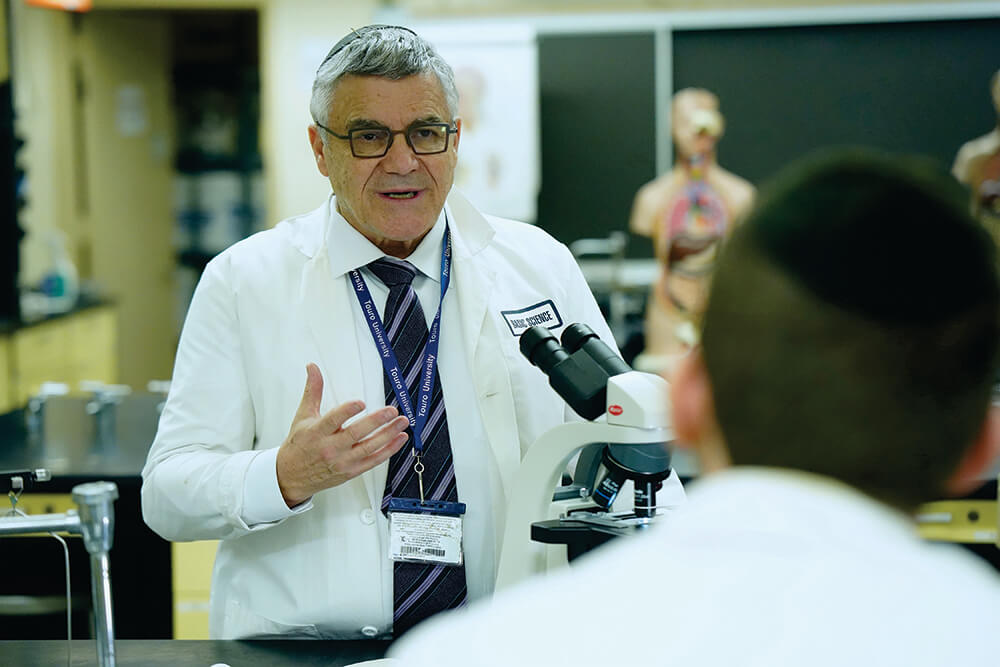
Dr. John Loike joined Touro’s Lander College of Arts & Sciences in the fall of 2017. Prior to joining the Touro family, the biomedical researcher served as the co-director for graduate studies in the Department of Physiology Cellular Biophysics and was director of special programs in the Center for Bioethics at Columbia University College of Physicians and Surgeons.
Dr. Loike’s biomedical research focuses on how human white blood cells combat infections and cancer. He also lectures internationally on emerging topics in bioethics and organizes international conferences. Loike has published articles on bioethics and specifically deals with bioethics from a Jewish perspective as well as the bioethics of new technologies, adding a religious angle to modern advances in science.
Could you tell us what medical professionals grapple with these days? What are the top issues: end of life, IVF treatments, transplants, gene editing?
One of the most challenging issues that medical professionals need to address is identifying and resolving ethical issues that arise from new biotechnologies such as gene editing and transplanting pig organs into humans. For example, new infertility therapies could involve a third party in generating an embryo (such as a gestational surrogate). The bioethical question here is the parental status of the third party.
In the classes you teach at Touro, what specifics do you focus on with your students?
At Touro, we design our courses to focus on two broad issues that are generally not offered at other universities. The first are the Jewish perspectives of innovative biomedical technologies including gene editing, immunotherapies for cancer and human reproduction. The second addresses common medical ethical problems such as the definition of death, patient autonomy in medical therapies and medical issues that challenge the bioethical guideline of respecting human dignity.
What topic most engages your students, and why do you think that is?
We are currently experiencing a scientific technological revolution. Students are fascinated with all the new biotechnologies, such as using hyperbaric chambers, a way to promote more blood flow to the brain in an effort to treat Alzheimer’s disease. They are also interested in the use of AI in healthcare, gene therapies to prolong human lifespan, and the development of personalized immunotherapies to effectively treat some of the most devastating diseases, such as cancer. This generation of students, who figuratively were born with cell phones, are always intrigued with how new technology interfaces with their lives.
Talk about the similarities of framing your bioethics from a Jewish perspective, as a Catholic or Evangelical or Muslim would do, that is through a religious framework.
All the major religions of the world have one common theme: to educate their populations and healthcare providers on how to maintain healthy lives and how to save humans from disease. Understanding the details of how various religions balance religious law and customs with new medical technologies can gain provide insights in how governments and societies can resolve or manage common medical ethical challenges.
